Published by:
CGP EDU Academic Team
Published on: August 21, 2026
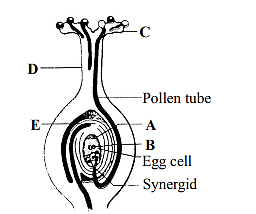
Identify A, B, C, D and E
A | B | C | D | E | |
(a) | Antipodal cells | Secondary nuclei | Stigma | Style | Chalaza |
(b) | Antipodal cells | Secondary nuclei | Style | Stigma | Chalaza |
(c) | Antipodal cells | Secondary nuclei | Stigma | Chalaza | Style |
(d) | Antipodal cells | Secondary nuclei | Chalaza | Stigma | Style |
Text Solution
Verified by ExpertsThe correct answer is:
A
No detailed text explanation provided yet.
Prepare Smarter with CGP Edu
Get practice questions, solutions, and test series in one place.
Write a Review
Share your experience with this question and solution.
Commentary
Send your comment, doubt, correction, or feedback to admin.
Similar Questions
Explore conceptually related problems
The energy required to ionize a hydrogen like ion in its ground state is 9 Rydberg's. What is the w…
A flask contains argon and oxygen in the ratio of 3:2 in mass and the mixture is kept at 27°C. The …
Hydrogen atom from excited state comes to the ground by emitting a photon of wavelength . The valu…
The activity of a radioactive material is 6.4 x 10 -4 curie. Its half life is 5 days. The activity …
The half life period of a radioactive substance is 60 days. The time taken for th of its original …
A radioactive sample decays times its original quantity in 15 minutes. The half-life of the sample…